
I’m not that much into pulling weeds, planting flowers, or gardening and such, but I like an oocasional TULIP now and then.
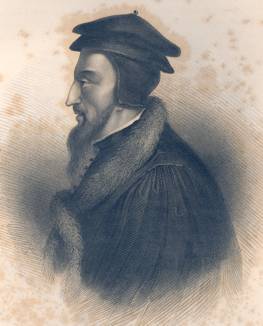
If you want to heat up a discussion (polite way of saying: screaming conversation) between a few Christians sitting around a coffee shop, just start talking about the 16th century French reformer, John Calvin, and the five points he put together as a refutation against Arminianism.
Most people don’t understand Calvinism, don’t know what the issues are and, frankly, don’t really care what all the fuss is about. Here is what TULIP stands for.
- T = Total Depravity
- U = Unconditional Election
- L = Limited Atonement
- I = Irresistible Grace
- P =Perseverance of the Saints
Here are the five points in a nutshell.
Total Depravity
Total Depravity is probably the most misunderstood tenet of Calvinism. When Calvinists speak of humans as “totally depraved,” they are making an extensive, rather than an intensive statement. The effect of the fall upon man is that sin has extended to every part of his personality — his thinking, his emotions, and his will. Not necessarily that he is intensely sinful, but that sin has extended to his entire being. The unregenerate (unsaved) man is dead in his sins (Romans 5:12). Without the power of the Holy Spirit, the natural man is blind and deaf to the message of the gospel (Mark 4:11f). The man without a knowledge of God will never come to this knowledge without God’s making him alive through Christ (Ephesians 2:1-5).
Unconditional Election
Unconditional Election is the doctrine which states that God chose those whom he was pleased to bring to a knowledge of himself, not based upon any merit shown by the object of his grace and not based upon his looking forward to discover who would “accept” the offer of the gospel. God has elected, based solely upon the counsel of his own will, some for glory and others for damnation (Romans 9:15,21). He has done this act before the foundations of the world (Ephesians 1:4-8). This doctrine does not rule out, however, man’s responsibility to believe in the redeeming work of God the Son (John 3:16-18). Scripture presents a tension between God’s sovereignty in salvation, and man’s responsibility to believe which it does not try to resolve. Both are true — to deny man’s responsibility is to affirm an unbiblical hyper-calvinism; to deny God’s sovereignty is to affirm an unbiblical Arminianism.
Limited Atonement
Limited Atonement is a doctrine offered in answer to the question, “for whose sins did Christ atone?” The Bible teaches that Christ died for those whom God gave him to save (John 17:9). Christ died, indeed, for many people, but not all (Matthew 26:28). Specifically, Christ died for the invisible Church — the sum total of all those who would ever rightly bear the name “Christian” (Ephesians 5:25). This doctrine often finds many objections, mostly from those who think that Limited Atonement does damage to evangelism. Christ’s death was not a death of potential atonement for all people. Believing that Jesus’ death was a potential, symbolic atonement for anyone who might possibly, in the future, accept him trivializes Christ’s act of atonement. Christ died to atone for specific sins of specific sinners. Christ died to make holy the church. He did not atone for all men, because obviously all men are not saved.
Irresistible Grace
The result of God’s Irresistible Grace is the certain response by the elect to the inward call of the Holy Spirit, when the outward call is given by the evangelist or minister of the Word of God. Christ, himself, teaches that all whom God has elected will come to a knowledge of him (John 6:37). Men come to Christ in salvation when the Father calls them (John 6:44), and the very Spirit of God leads God’s beloved to repentance (Romans 8:14).
Perseverance of the Saints
Perseverance of the Saints is a doctrine which states that the saints (those whom God has saved) will remain in God’s hand until they are glorified and brought to abide with him in heaven. Romans 8:28-39 makes it clear that when a person truly has been regenerated by God, he will remain in God’s stead. The work of sanctification which God has brought about in his elect will continue until it reaches its fulfillment in eternal life (Phil. 1:6). Christ assures the elect that he will not lose them and that they will be glorified at the “last day” (John 6:39).
Question for commenting: How do you feel about these five points? What do you agree with and what do you disagree with? And how do these points help us to understand man’s responsibility and God’s sovereignty? Lastly, how do these points help us in understanding the role of evangelism?
How do you feel about these five points? What do you agree with and what do you disagree with? And how do these points help us to understand man’s responsibility and God’s sovereignty? Lastly, how do these points help us in understanding the role of evangelism?
First, just a quick clarification. John Calvin did not write the 5 points, the Synod of Dort did as they refuted the Remonstrance. But, they did come from his teachings.
Secondly, at a basic level I think the “5 points” helps to define the conversation. However, sometimes I think they are unhelpful because there is so much more to Calvinism than those 5 points. For example, John Calvin was involved in over 2,000 church plants! He was about the Gospel and the work of the Gospel spreading over the earth!
There is my two cents 🙂
Jeremy….you’re right in that there’s a lot more to it than what my brief article offers. Thanks for providing a bit more clarification regarding the Remonstrance, etc. Very helpful!
And yes, there’s a lot more to Calvinism than five points. But I can’t stand long articles. 😉
I didn’t know that about Calvin’s church planting. But how in the world was he involved in over 2,000 of them? Even if he did 100 each year, that would take 20 years, and I can’t see how anyone could even plant 10 churches in a year, let alone something close to 100.
I gotta fall into the Arminianist camp. There’s a lot of scripture which I believe refutes Calvinism but for the sake of time I usually just put forth the following observation; the doctrine of Unconditional Election appears to be a violation of the second greatest commandment. Here’s the reasoning. God stated He came to fulfill the law. The second greatest commandment was and will be fulfilled by Him. So the question is, how is this law fulfilled? What criterion is needed in any given situation that would require the fulfilling of and obedience to this law? This criterion is given to us by God in the parable of the Good Samaritan. And it is this; the injured man needed love (mercy), and it was within the Samaritan’s power to offer that love (mercy). There is no other criterion given which causes the requirement of obedience to this law. Here’s an important point, this law is fulfilled not by the receiving of mercy, but by the offer of mercy. If the injured man had come to and for some reason refused the help the Samaritan was offering, the Samaritan had still fulfilled the law in the offering of mercy.
Tom, thanks for the comment, brother.
Yes, I could spend a few years preaching a series about salvation while preaching God’s sovereignty one Sunday and then changing the next Sunday to man’s sole responsibility, etc. These are difficult to understand how they mesh, but I also don’t think we are supposed to, necessarily.
A person (like me) might not agree with everything Calvinism teaches, but there is a good portion of it that I personally believe is right on.
The main issue is that there are loads of Bible passages that teach God’s sovereignty and there are loads that teach man’s responsibility. How those two go together, no one has yet been able to adequately articulate. So either we’re to stupid to understand it or it is a mystery withheld from us until a later time, or in glory. And I think it is being withheld.
I always go back to Romans 9:19-20 because even the great Apostle Paul couldn’t answer it. He simply left it unanswered and rebuked the questioner for not believing in God’s sovereignty. Thanks Tom!
Romans 9:19-20 “You will say to me then, “Why does He still find fault? For who has resisted His will?” But indeed, O man, who are you to reply against God? Will the thing formed say to him who formed it, “Why have you made me like this?”
Why is it when one does not hold to Five Point Calvinism or Double Predestination it is because we don’t understand it?
Please see my response to Tom Bridges below.
I don’t think anyone can truly “understand” how God’s sovereignty in salvation meshes with man’s responsibility. I think it is a mystery.
Being a Mystery then there could be room for error on our part then?
Certainly could be. If it is a “mystery” withheld from us then we can’t be 100% “certain” as to whether or not we’re correct. I hate to use the word “subjective, but there is a fair amount of it when we start trying articulate how God’s sovereignty and man’s responsibility mesh.
Hey Charles, I agree subjectivity is unavoidable. But isn’t that why we imploy hermeneutics? Exegesis over eisegesis. That’s why I go to the clear and easily understood verses to interpret the difficult ones (like Luke 10 over Romans 9). Good hermeneutics. If you use the difficult verses to interpret the easier verses it results in scripture twisting by inserting hidden meanings into clear text (as in John 3:16 referring only to the elect).
Certainly we should use sound hermeneutic practices. But even superb hermeneutics wouldn’t have caused an OT saint to come to the conclusion that the gentiles are also part of God’s plan. It was a mystery. I think the same thing goes here.
It is wise to use other passages to help us to interpret more difficult ones. But we need to be sure we have rightly interpreted those other passages, otherwise we’ll be wrong on more than just one!
You get my point exactly tom if the mystery is a true mystery that is beauty. On the other hand if the mystery is our interpretive model then the mystery is an intellectual deflection. Because our model has reached it’s end, in any other discipline of thought this would require some re-thinking, that is except doctrine.
Thanks Charles, this is a keeper.
Great, Kristi, I’m glad you liked it.
PS: still waiting on that article from you about adoption. 😉
(no pressure)
Re:
How do you feel about these five points? I’m sad I fit into the “T”, but it’s the truth. And I LOVE the “U” “L” “I” “P” categories!!
We’re all totally depraved. But we have a totally merciful God!
Thanks for the article, Tom.
Over the years, I’ve known quite a few people who claim to be “partial” Calvinists, like a 4-point Calvinist, or in the case of one individual, a 3.5-point Calvinist. 🙂 This fascinates me, because the points of Calvinism logically and necessarily build on each other, beginning with Total Depravity, on which the whole view stands. In other words, if you throw out Total Depravity, then you have to throw it all out, but if you accept Total Depravity, then you have to keep it all. It’s all or nothing. What do you think about this?
Was glad to see “sanctification” mentioned under Perseverance of the Saints and not just a general assurance of salvation. This “increasing holiness” truth is much overlooked in American Christianity today.
Praise God His mercy!
I agree with all 5 =) Thanks for posting!